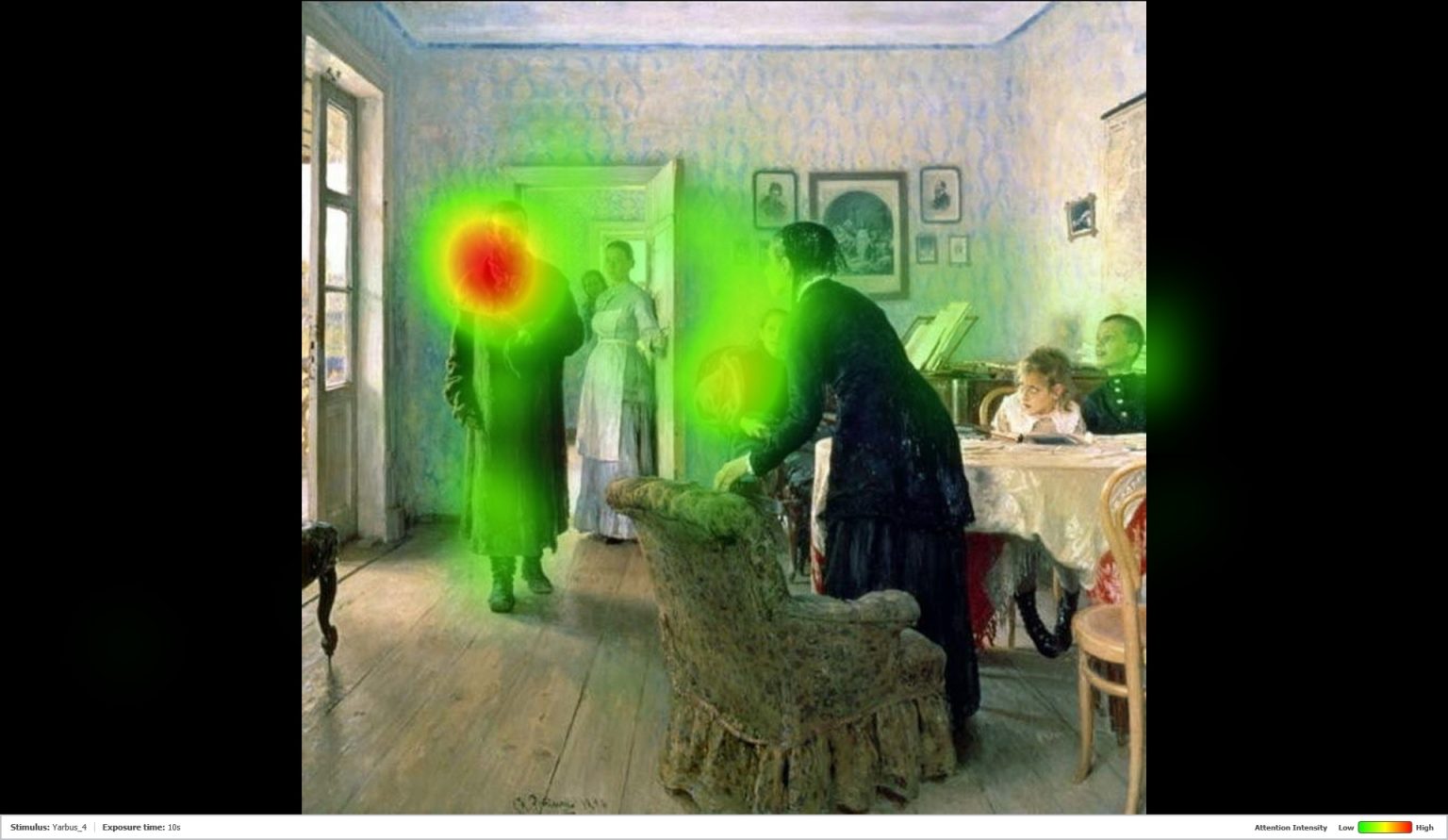
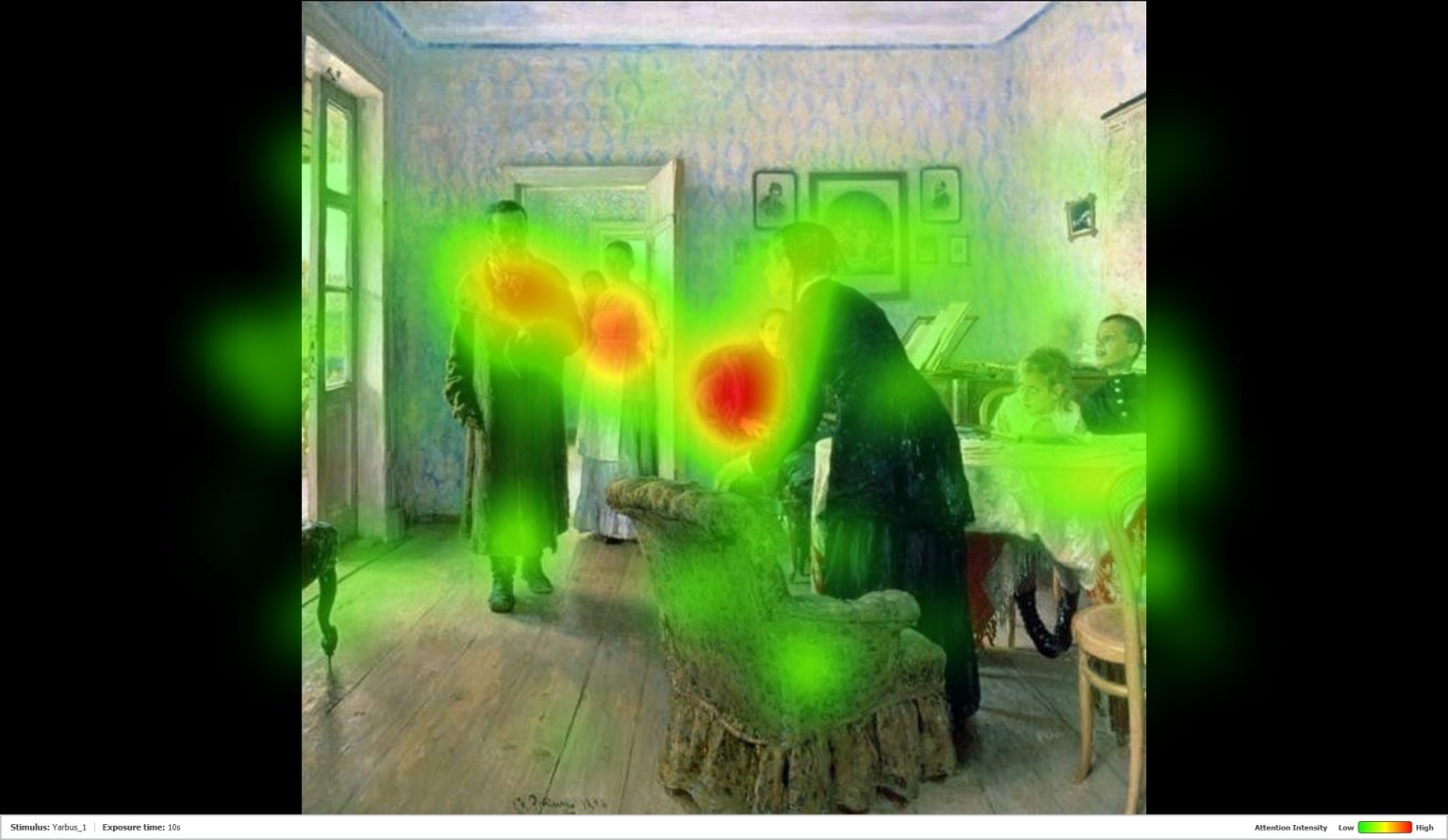
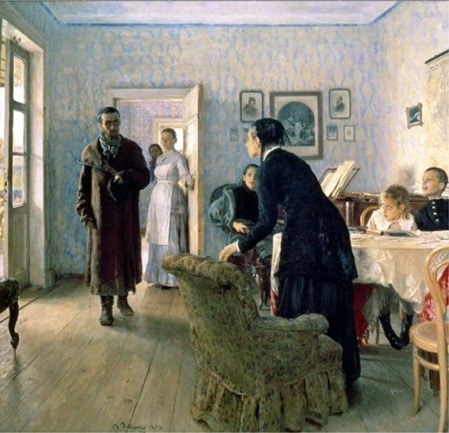
Heat maps intrigue me (I create them frequently for my own neuroscience projects), and this old and classic set caught my eye recently. Scroll to see both heat maps and the original picture, which is, in fact, a classic painting titled The Unexpected Visitor by Ilya Repin. Notice how even though the painting is the same under both heat maps, the heat maps are not. The explanation begins with an eye-tracking experiment conducted more than 60 years ago.
Psychologist Alfred Yarbus asked one observer to examine the painting 7 times, for three minutes each. Each time, the observer was asked to do different things: In one segment, he was asked to look over the painting freely. In another, he was asked to estimate the family’s material circumstances, judge the people’s ages, remember their clothes, remember their positions in the room, infer what the family had been doing before the visitor arrived, or estimate how long the visitor had been away. Yarbus’s original recordings were scanpaths (meaning lines tracing the movement of the eye) rather than heat maps.
Many years later, with more advanced eye-tracking tools, the classic Yarbus experiment has been revalidated. The two modern heat maps below represent only 2 of those 7 conditions. In the first, participants estimated how long the visitor had been away and noticed how attention concentrates strongly on the visitor’s face. In the second (scroll to the right to see it), they estimated the family’s material circumstances and notice how attention spreads more widely across the people and parts of the room. Even though the painting is the same each time, the eyes process it differently.
This has a practical application for anyone who creates any communication materials that should attract the eyes in some way. Keep in mind that the goal a viewer brings to an image can influence where they look. If you know their goals, then communication design is easier, but if you do not, then, before designing anything, complete this sentence: “I want the audience to find.....” Before adding another arrow, color, or animation, give the eyes a useful job.