It's not that useful to count slides
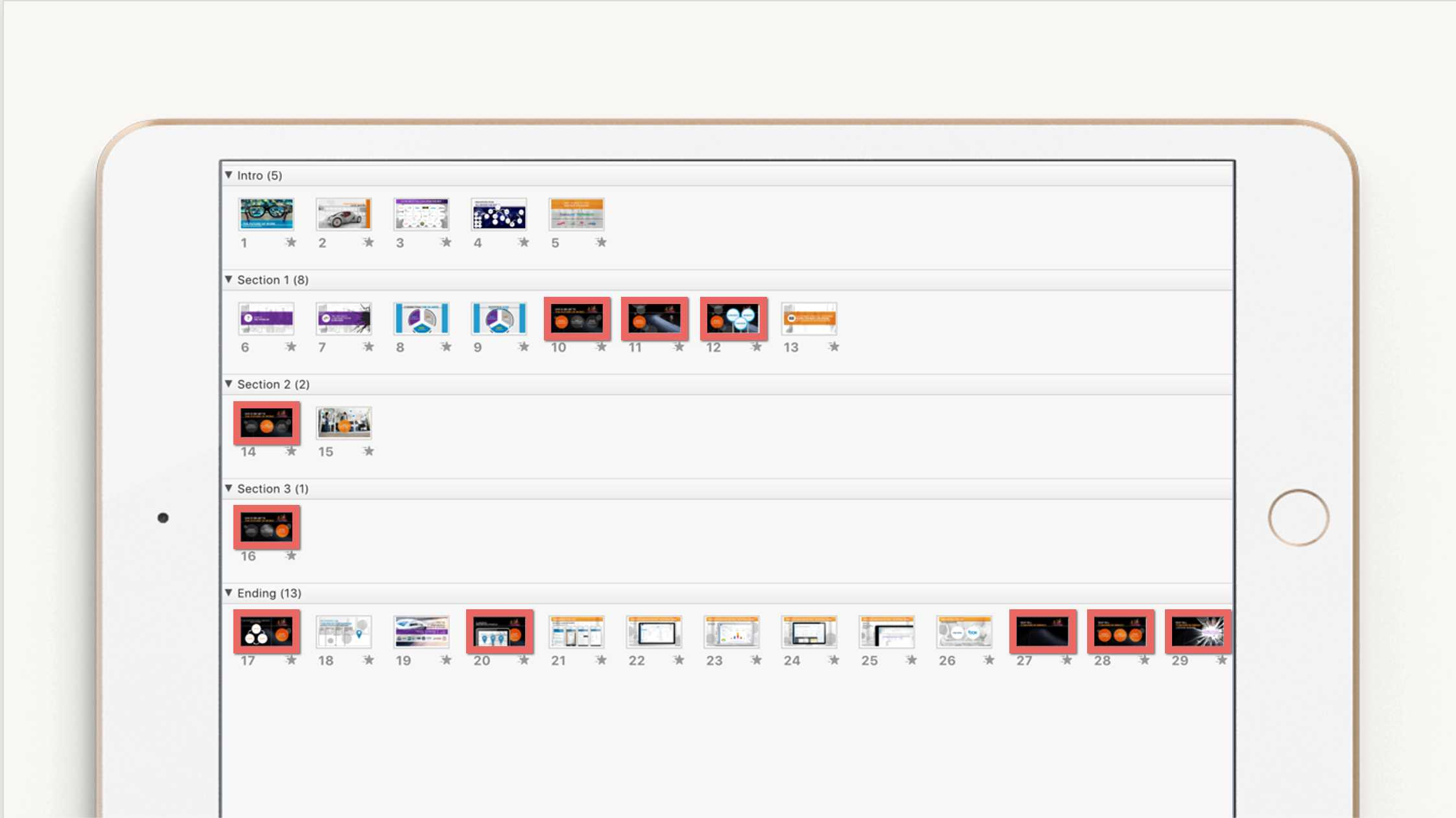
Here is the slide sorter view of a presentation we created for a client (the slide sorter view is really useful in showing you patterns). Note that the highlighted slides are what we call the 10% slide, meaning the slide that the client wants to remember. Typically, this slide has one main message and 3 supporting points, it is designed in a way that is distinct from everything else, and repeated often. I am sharing this example because it counters an observation I often see clients make: they don't want a long presentation. 10-12 slides, they say, max... There is no evidence that shows you will be more successful during a 30-minute meeting if you share 12 slides vs. 30.
A better metric to consider is whether you have a strong/distinctive message, how often you repeat it, and how much engagement it generates. Notice in this sequence that for the third section, there are no supporting slides. meaning that, in this case, the third point was so unique that it generated a lot of reactions and questions from the client's client, and that slide stayed there throughout the entire segment, further reinforcing the main message. And, depending on general interest, the presentation could finish at slide 16 or keep going a bit longer, with additional evidence shown around the same mental model.
Consider this: A 12-slide deck can feel exhausting if every slide introduces a new idea. A 30-slide deck can feel light if many slides are quick, visual, repetitive, or used as anchors for conversation. So, two guidelines emerge from this that you can address with two questions: 1) do you have any supporting points in your communication that are so distinct they do not require any visual because they can generate discussion on their own? And 2) can you shift deck design from asking "how long is this deck," to asking "how flexible is this deck," meaning that depending on the situation, you can take a short path or a longer path?