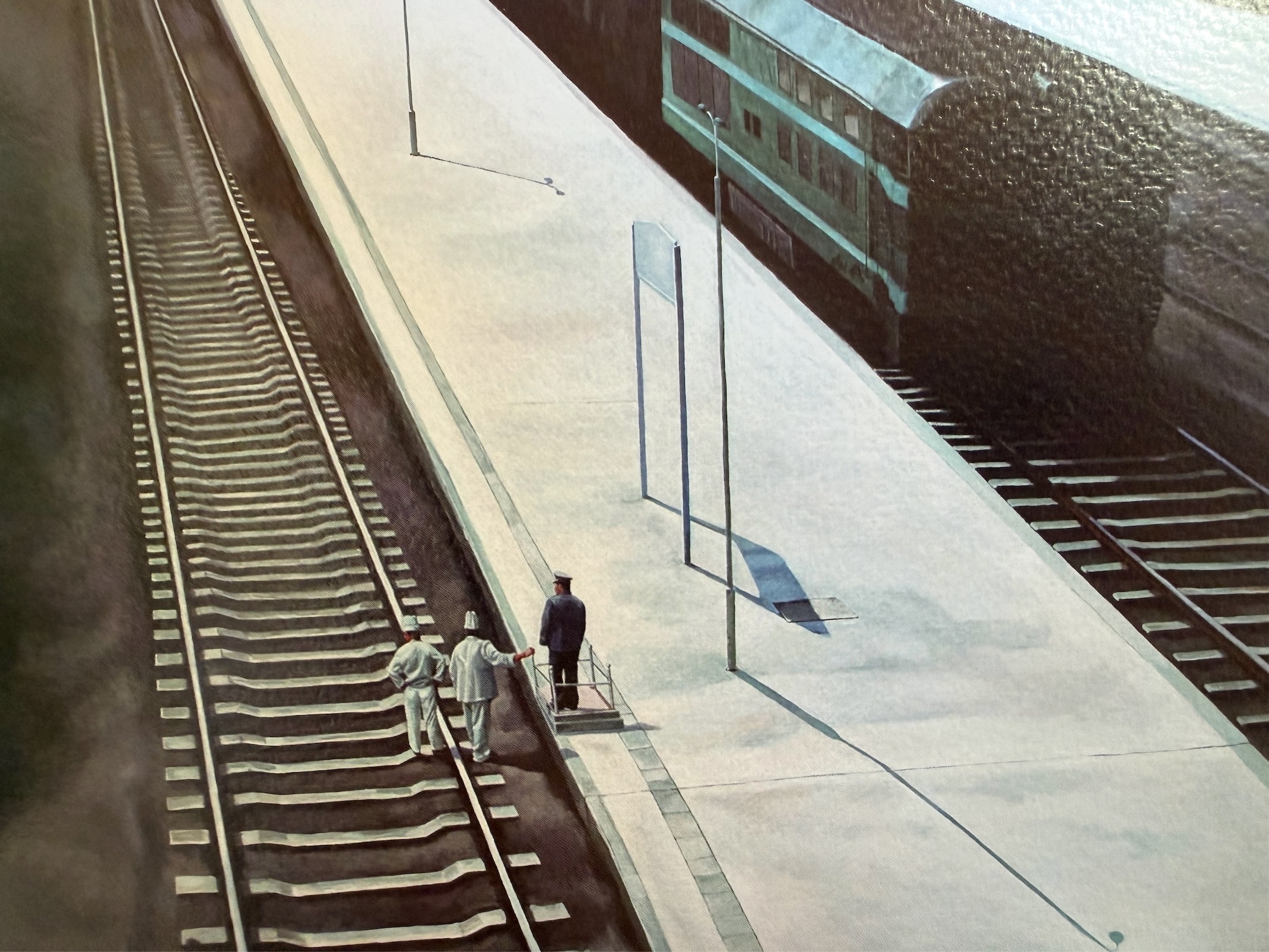
We can learn a lot from Liu Weijian, a Chinese artist in Shanghai known for his muted, "anti-expressionist" depictions of everyday urban objects and modern environments. Weijian describes his painting style as having a sense of movement or unfinished business and you can detect this by looking at this painting called Platform: the scene feels tense even though nothing dramatic is really happening. Even though this is an ordinary scene, it can carry a lot of emotional power through the distance between the people, the presence of shadows and contrasts between light and darks spaces, what is present, what is missing...
Based on the author’s comments about his work, it is possible that the train station suggests a transitional state of many young people arriving from other provinces to start a new life in a large city. Whenever the artist speaks about the human figures he paints, he admits that they are rendered small and isolated, perhaps alluding to the vulnerability of the individual against overpowering modern settings. Regardless of this, notice how we do not see people’s faces, like you would in some cliché business content. Rather, the author is showcasing the condition that makes the moment seem emotionally charged. So, as a practical guideline, consider creating a context that invites the audience to make some inferences, to supply some of their own possible explanations, and not fill in every single pixel with telling details. You don’t have to show everything to hold attention; sometimes a carefully chosen gap gives the audience something to do.